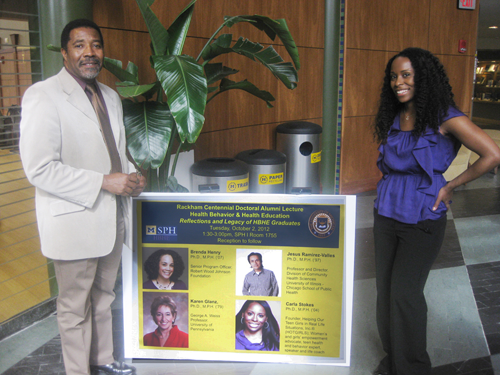
Dr. Carla with her dissertation co-chair, Dr. Larry M. Gant, professor in the University of Michigan School of Social Work and the Penny W. Stamps School of Art & Design, following her invited Rackham Graduate School Centennial Doctoral Alumni Lecture in the Department of Health Behavior and Health Education.
Research Interests
 Dr. Carla Stokes is a pioneering educator and scholar whose work helped lay the foundation for digital girlhood studies, introduced innovative research methods for studying adolescents’ online lives, and integrated hip hop culture and the internet into health education. Her groundbreaking research helped shape contemporary understanding of adolescence and girlhood in the digital age.
Dr. Carla’s research interests include:
- Black Girlhood and Digital Girlhood Studies
- Adolescent Identity Development and Risk-Taking Behavior
- Adolescent Sexuality, Relationships, and Dating Violence
- Social Media, Digital Self-Representation, Avatar Cultures, and Emerging Technologies
- The Impact of Artificial Intelligence on Girls’ Health, Development, and Well-Being
- Qualitative and Mixed-Methods Research, Digital Ethnography, and Online Research Methods
- Youth-Based Participatory Action Research (YBPAR)
- Hip Hop Culture, Media, and Youth Development
- Social Determinants of Health and Racial and Ethnic Health Disparities
Her interdisciplinary research examines the social and cultural forces that shape identity, health, development, and well-being, with particular emphasis on Black girlhood, adolescent development, social media, popular culture, and emerging technologies. Grounded in scholarship from public health, psychology, anthropology, communication, media studies, education, social work, gender and sexuality studies, and digital studies, Dr. Carla’s scholarship bridges multiple disciplines to better understand the social and cultural forces that shape health, identity, development, behavior, and well-being among adolescents and women.
Foundational Research
Research Contributions
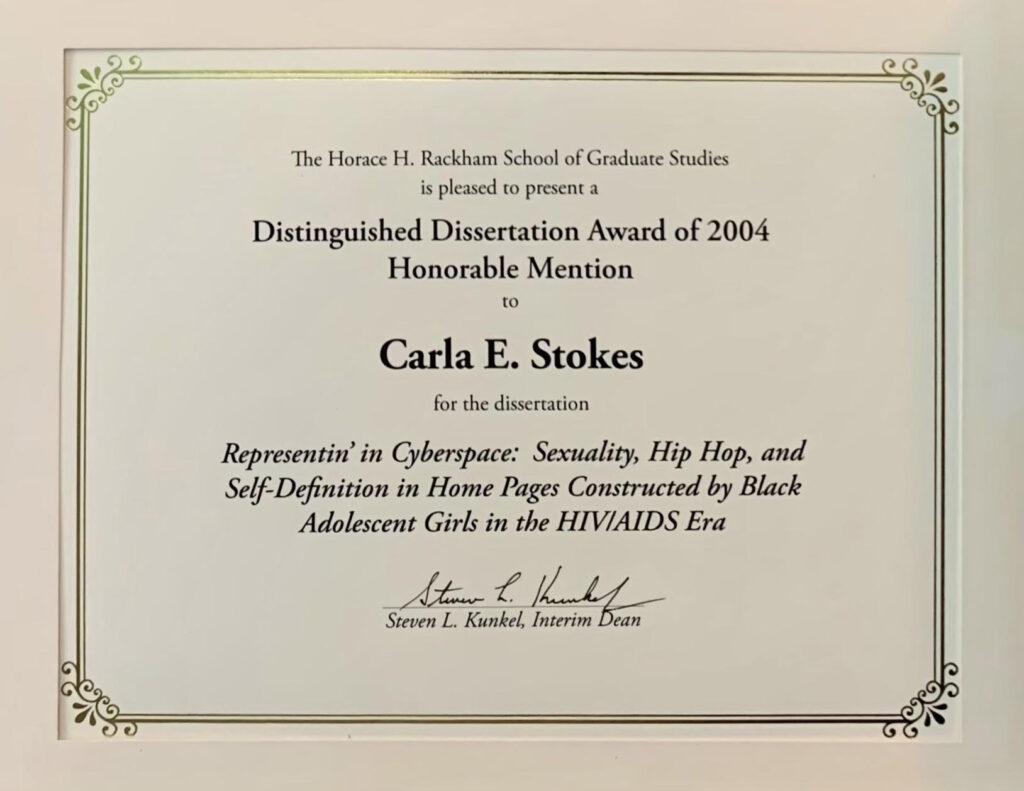 Carla’s groundbreaking research at the University of Michigan examined sexuality, hip hop culture, identity development, and self-definition in social networking profiles (“home pages”) created by 216 Black adolescent girls living in Southern states with the highest rates of HIV/AIDS.
As one of the earliest cyber ethnographers studying young people’s online lives, her research highlighted the significance of hip hop culture and emerging social networking environments in shaping the sexual self-definition and identity formation of Black adolescent girls at the turn of the 21st century. The study established emerging social networking environments as important sites of adolescent development where young people negotiated identity, sexuality, relationships, and other central developmental tasks. The dissertation was among the first empirical studies to document cyberbullying, online harassment, and the sexualization of girls online, and was also the first published study of Black adolescent girls’ social networking profiles.
Dr. Carla’s research documented some of the earliest forms of digital self-presentation, digital remix culture, avatar-based identity expression, and visual identity construction among adolescents and created a rare empirical record of youth culture during the emergence of social networking. The study anticipated many of today’s central questions about social media, adolescent mental health, digital identity, online sexualization, and youth development. This work also serves as the intellectual foundation for Dr. Carla’s interdisciplinary scholarship at the intersection of girlhood, media, identity, and the arts.
Methodological Innovation
At the time of the study, qualitative research in online environments was still an emerging area of inquiry, and researchers had few established methodological or ethical guidelines. To address these challenges, Dr. Carla designed an innovative three-phase, mixed-methods research strategy that combined cyber ethnography, quantitative and qualitative content analysis, and respondent validation to strengthen the interpretation of the findings. In addition, she conducted the study in consultation with an expert advisory panel of Black adolescent girls from the Atlanta metropolitan area whose perspectives informed the research process. The study also adapted emerging technologies and qualitative data analysis software to systematically archive, organize, and analyze dynamic web pages as they changed over time. These research design, data management, and analytic innovations established new methodological approaches for adapting qualitative research to online environments.
Dr. Carla received Honorable Mention in the ProQuest Distinguished Dissertation Awards competition. The awards recognize highly accomplished doctoral students who have produced exceptional dissertations of outstanding scholarly quality. Her dissertation was one of 39 dissertations nominated from among the 660 doctoral dissertations completed at the University of Michigan in 2004 across a broad range of disciplines.

Dr. Carla was also one of four distinguished doctoral alumni from the University of Michigan’s Department of Health Behavior and Health Education selected to deliver an invited lecture as part of the Rackham Graduate School’s Centennial celebration, which recognized the noteworthy career accomplishments and scholarly achievements of the department’s graduates.
Research Training

Dr. Carla at University of Michigan School of Public Health
Dr. Carla earned her PhD and Master of Public Health in Health Behavior and Health Education from the University of Michigan, where she completed a doctoral cognate in Social Work. She was awarded a Bachelor of Arts in Psychology with departmental honors from Spelman College.
During her doctoral training at the University of Michigan, Dr. Carla was a National Institutes of Health-funded doctoral trainee through the Center for Research on Ethnicity, Culture, and Health, where she received advanced training in racial and ethnic health disparities, health equity, community-based research, and the social and cultural influences on health. Her doctoral education included interdisciplinary coursework and mentorship from leading experts whose pioneering work has shaped the study of public health, social epidemiology, health psychology, medical anthropology, sociology, maternal and child health, adolescent health, and health disparities research.

Dr. Carla with University of Michigan mentors Dr. Arline T. Geronimus and Dr. Sherman A. James at the 2014 JEDI Public Health Workshop, sponsored by the University of Michigan’s Center for Advancing Research and Solutions for Society (CARSS), Center for Research on Ethnicity, Culture, and Health (CRECH), and Population Studies Center.
Selected Publications
Dr. Carla’s research at the intersections of Black girlhood, adolescent development, social media, hip hop culture, and digital studies has been published in academic books, peer-reviewed journals, and edited volumes, including Girl Wide Web 2.0: Revisiting Girls, the Internet, and the Negotiation of Identity, edited by Sharon Mazzarella, and Sex Matters: The Sexuality and Society Reader (4th Edition), edited by Mindy Stombler et al. Her scholarship on Black girls and digital girlhood has been assigned as required reading in university courses spanning sexuality studies, digital studies, women’s and girls’ studies, anthropology, public health, Africana studies, media studies, and other interdisciplinary fields at institutions ranging from Ivy League universities to small liberal arts colleges.

Stokes, C.E. (2014). Representin’ in cyberspace: Sexual scripts, self-definition, and hip hop culture in black American adolescent girls’ home pages. In Stombler, M., Simonds, W., Baunach, D.M., Burgess, E.O. (Eds.). Sex matters: The Sexuality and society reader, 4th Edition. (pp. 116-127). W.W. Norton & Company. https://books.google.com/books/about/Sex_Matters
Stokes, C.E. (2010). “Get on my level!”: How black American adolescent girls construct identity and negotiate sexuality on the Internet. In Sharon R. Mazzarella (Ed.). Girl Wide Web 2.0: Revisiting girls, the Internet, and the negotiation of identity. (pp. 45-67) Peter Lang Publishers. https://books.google.com/books?id=lVHAO2ZtFvAC
 Stokes, C.E. (2007, March-April). Representin’ in cyberspace: Sexual scripts, self-definition, and hip hop culture in black American adolescent girls’ home pages. Culture, Health & Sexuality, 9(2): 169-184. https://pubmed.ncbi.nlm.nih.gov/17364724/
Stokes, C.E. (2004) Representin’ In Cyberspace: Sexuality, Hip Hop, and Self-Definition In Home Pages Constructed By Black Adolescent Girls In The HIV/AIDS Era. Doctoral Dissertation, Department of Health Behavior and Health Education, University of Michigan, Ann Arbor. https://deepblue.lib.umich.edu/handle/2027.42/124572
Stokes C.E. & Gant L.M. (2002). Turning the tables on the HIV/AIDS epidemic: Hip hop as a tool for reaching African-American adolescent girls. African American Research Perspectives, 8(2), 70-81. https://prba.isr.umich.edu/wp-content/uploads/2024/06/stokes.pdf
Selected Research Fellowships and Grants
Dr. Carla’s research has been supported by a number of institutions, fellowships, and grants.
 U.S. Centers for Disease Control and Prevention, Division of HIV Prevention, National Center for HIV, Viral Hepatitis, STD, and Tuberculosis Prevention. HIV Prevention in Communities of Color Postdoctoral Research Fellowship. Dr. Carla completed a two-year postdoctoral research appointment investigating HIV prevention in communities of color and further explored the ways in which adolescent girls use media and hip hop culture to negotiate their sexuality, construct identity, and navigate adolescence.
- National Institutes of Health/University of Michigan Center for Research on Ethnicity, Culture, and Health Doctoral Training Fellowship
 Congressional Black Caucus Foundation Public Health Fellowship
- W.K. Kellogg Foundation Health Policy Research Fellowship Program
- Johnson & Johnson Dissertation Grants Program in Women’s Health
- University of Michigan Collaboratory for Advanced Research and Academic Technologies
- University of Michigan Institute for Research on Women and Gender